 Hello丶World查看:110 回复:0 评论:0 创建时间:2021-05-19T17:08:58
用户:Hello丶World查看:110 回复:0 评论:0 创建时间:2021-05-19T17:08:58
【作品展示】
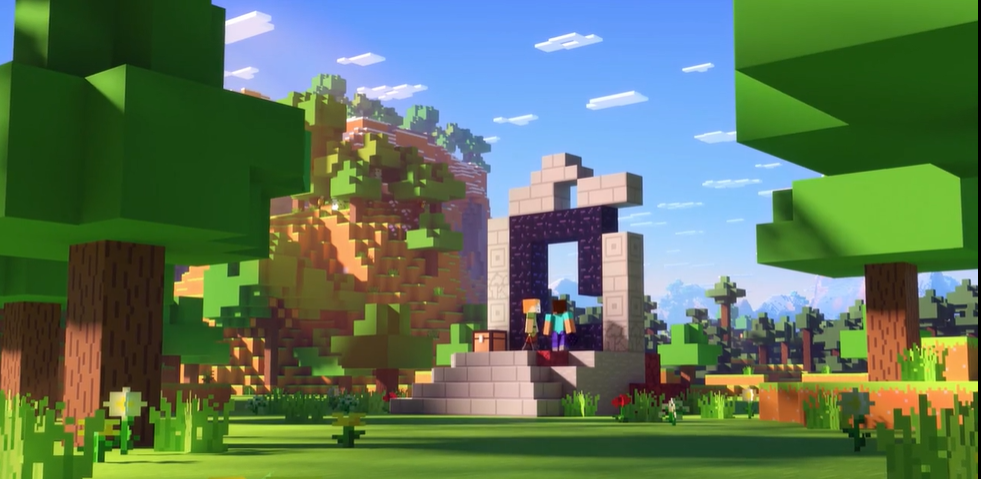
【作品介绍】
我的世界,初阶版
【作品源代码】
from __future__ import division

import sys
import math
import random
import time

from collections import deque
from pyglet import image
from pyglet.gl import *
from pyglet.graphics import TextureGroup
from pyglet.window import key, mouse

TICKS_PER_SEC = 60

SECTOR_SIZE = 16

WALKING_SPEED = 5
FLYING_SPEED = 15

GRAVITY = 20.0
MAX_JUMP_HEIGHT = 1.0 # About the height of a block.
JUMP_SPEED = math.sqrt(2 * GRAVITY * MAX_JUMP_HEIGHT)
TERMINAL_VELOCITY = 50

PLAYER_HEIGHT = 2

if sys.version_info[0] >= 3:
    xrange = range

def cube_vertices(x, y, z, n):
    return [
        x-n,y+n,z-n, x-n,y+n,z+n, x+n,y+n,z+n, x+n,y+n,z-n,  # top
        x-n,y-n,z-n, x+n,y-n,z-n, x+n,y-n,z+n, x-n,y-n,z+n,  # bottom
        x-n,y-n,z-n, x-n,y-n,z+n, x-n,y+n,z+n, x-n,y+n,z-n,  # left
        x+n,y-n,z+n, x+n,y-n,z-n, x+n,y+n,z-n, x+n,y+n,z+n,  # right
        x-n,y-n,z+n, x+n,y-n,z+n, x+n,y+n,z+n, x-n,y+n,z+n,  # front
        x+n,y-n,z-n, x-n,y-n,z-n, x-n,y+n,z-n, x+n,y+n,z-n,  # back
    ]


def tex_coord(x, y, n=4):
    m = 1.0 / n
    dx = x * m
    dy = y * m
    return dx, dy, dx + m, dy, dx + m, dy + m, dx, dy + m


def tex_coords(top, bottom, side):
    top = tex_coord(*top)
    bottom = tex_coord(*bottom)
    side = tex_coord(*side)
    result = []
    result.extend(top)
    result.extend(bottom)
    result.extend(side * 4)
    return result


TEXTURE_PATH = 'texture.png'

GRASS = tex_coords((1, 0), (0, 1), (0, 0))
SAND = tex_coords((1, 1), (1, 1), (1, 1))
BRICK = tex_coords((2, 0), (2, 0), (2, 0))
STONE = tex_coords((2, 1), (2, 1), (2, 1))

FACES = [
    ( 0, 1, 0),
    ( 0,-1, 0),
    (-1, 0, 0),
    ( 1, 0, 0),
    ( 0, 0, 1),
    ( 0, 0,-1),
]


def normalize(position):
    x, y, z = position
    x, y, z = (int(round(x)), int(round(y)), int(round(z)))
    return (x, y, z)


def sectorize(position):
    x, y, z = normalize(position)
    x, y, z = x // SECTOR_SIZE, y // SECTOR_SIZE, z // SECTOR_SIZE
    return (x, 0, z)


class Model(object):

    def __init__(self):

        # A Batch is a collection of vertex lists for batched rendering.
        self.batch = pyglet.graphics.Batch()

        # A TextureGroup manages an OpenGL texture.
        self.group = TextureGroup(image.load(TEXTURE_PATH).get_texture())

        # A mapping from position to the texture of the block at that position.
        # This defines all the blocks that are currently in the world.
        self.world = {}

        # Same mapping as `world` but only contains blocks that are shown.
        self.shown = {}

        # Mapping from position to a pyglet `VertextList` for all shown blocks.
        self._shown = {}

        # Mapping from sector to a list of positions inside that sector.
        self.sectors = {}

        # Simple function queue implementation. The queue is populated with
        # _show_block() and _hide_block() calls
        self.queue = deque()

        self._initialize()

    def _initialize(self):
        n = 80  # 1/2 width and height of world
        s = 1  # step size
        y = 0  # initial y height
        for x in xrange(-n, n + 1, s):
            for z in xrange(-n, n + 1, s):
                # create a layer stone an grass everywhere.
                self.add_block((x, y - 2, z), GRASS, immediate=False)
                self.add_block((x, y - 3, z), STONE, immediate=False)
                if x in (-n, n) or z in (-n, n):
                    # create outer walls.
                    for dy in xrange(-2, 3):
                        self.add_block((x, y + dy, z), STONE, immediate=False)

        # generate the hills randomly
        o = n - 10
        for _ in xrange(120):
            a = random.randint(-o, o)  # x position of the hill
            b = random.randint(-o, o)  # z position of the hill
            c = -1  # base of the hill
            h = random.randint(1, 6)  # height of the hill
            s = random.randint(4, 8)  # 2 * s is the side length of the hill
            d = 1  # how quickly to taper off the hills
            t = random.choice([GRASS, SAND, BRICK])
            for y in xrange(c, c + h):
                for x in xrange(a - s, a + s + 1):
                    for z in xrange(b - s, b + s + 1):
                        if (x - a) ** 2 + (z - b) ** 2 > (s + 1) ** 2:
                            continue
                        if (x - 0) ** 2 + (z - 0) ** 2 < 5 ** 2:
                            continue
                        self.add_block((x, y, z), t, immediate=False)
                s -= d  # decrement side lenth so hills taper off

    def hit_test(self, position, vector, max_distance=8):
        m = 8
        x, y, z = position
        dx, dy, dz = vector
        previous = None
        for _ in xrange(max_distance * m):
            key = normalize((x, y, z))
            if key != previous and key in self.world:
                return key, previous
            previous = key
            x, y, z = x + dx / m, y + dy / m, z + dz / m
        return None, None

    def exposed(self, position):
        x, y, z = position
        for dx, dy, dz in FACES:
            if (x + dx, y + dy, z + dz) not in self.world:
                return True
        return False

    def add_block(self, position, texture, immediate=True):
        if position in self.world:
            self.remove_block(position, immediate)
        self.world[position] = texture
        self.sectors.setdefault(sectorize(position), []).append(position)
        if immediate:
            if self.exposed(position):
                self.show_block(position)
            self.check_neighbors(position)

    def remove_block(self, position, immediate=True):
        del self.world[position]
        self.sectors[sectorize(position)].remove(position)
        if immediate:
            if position in self.shown:
                self.hide_block(position)
            self.check_neighbors(position)

    def check_neighbors(self, position):
        x, y, z = position
        for dx, dy, dz in FACES:
            key = (x + dx, y + dy, z + dz)
            if key not in self.world:
                continue
            if self.exposed(key):
                if key not in self.shown:
                    self.show_block(key)
            else:
                if key in self.shown:
                    self.hide_block(key)

    def show_block(self, position, immediate=True):
        texture = self.world[position]
        self.shown[position] = texture
        if immediate:
            self._show_block(position, texture)
        else:
            self._enqueue(self._show_block, position, texture)

    def _show_block(self, position, texture):
        x, y, z = position
        vertex_data = cube_vertices(x, y, z, 0.5)
        texture_data = list(texture)
        # create vertex list
        # FIXME Maybe `add_indexed()` should be used instead
        self._shown[position] = self.batch.add(24, GL_QUADS, self.group,
            ('v3f/static', vertex_data),
            ('t2f/static', texture_data))

    def hide_block(self, position, immediate=True):
        self.shown.pop(position)
        if immediate:
            self._hide_block(position)
        else:
            self._enqueue(self._hide_block, position)

    def _hide_block(self, position):
        self._shown.pop(position).delete()

    def show_sector(self, sector):
        for position in self.sectors.get(sector, []):
            if position not in self.shown and self.exposed(position):
                self.show_block(position, False)

    def hide_sector(self, sector):
        for position in self.sectors.get(sector, []):
            if position in self.shown:
                self.hide_block(position, False)

    def change_sectors(self, before, after):
        before_set = set()
        after_set = set()
        pad = 4
        for dx in xrange(-pad, pad + 1):
            for dy in [0]:  # xrange(-pad, pad + 1):
                for dz in xrange(-pad, pad + 1):
                    if dx ** 2 + dy ** 2 + dz ** 2 > (pad + 1) ** 2:
                        continue
                    if before:
                        x, y, z = before
                        before_set.add((x + dx, y + dy, z + dz))
                    if after:
                        x, y, z = after
                        after_set.add((x + dx, y + dy, z + dz))
        show = after_set - before_set
        hide = before_set - after_set
        for sector in show:
            self.show_sector(sector)
        for sector in hide:
            self.hide_sector(sector)

    def _enqueue(self, func, *args):
        self.queue.append((func, args))

    def _dequeue(self):
        func, args = self.queue.popleft()
        func(*args)

    def process_queue(self):
        start = time.clock()
        while self.queue and time.clock() - start < 1.0 / TICKS_PER_SEC:
            self._dequeue()

    def process_entire_queue(self):
        while self.queue:
            self._dequeue()


class Window(pyglet.window.Window):

    def __init__(self, *args, **kwargs):
        super(Window, self).__init__(*args, **kwargs)

        # Whether or not the window exclusively captures the mouse.
        self.exclusive = False

        # When flying gravity has no effect and speed is increased.
        self.flying = False

        # Strafing is moving lateral to the direction you are facing,
        # e.g. moving to the left or right while continuing to face forward.
        #
        # First element is -1 when moving forward, 1 when moving back, and 0
        # otherwise. The second element is -1 when moving left, 1 when moving
        # right, and 0 otherwise.
        self.strafe = [0, 0]

        # Current (x, y, z) position in the world, specified with floats. Note
        # that, perhaps unlike in math class, the y-axis is the vertical axis.
        self.position = (0, 0, 0)

        # First element is rotation of the player in the x-z plane (ground
        # plane) measured from the z-axis down. The second is the rotation
        # angle from the ground plane up. Rotation is in degrees.
        #
        # The vertical plane rotation ranges from -90 (looking straight down) to
        # 90 (looking straight up). The horizontal rotation range is unbounded.
        self.rotation = (0, 0)

        # Which sector the player is currently in.
        self.sector = None

        # The crosshairs at the center of the screen.
        self.reticle = None

        # Velocity in the y (upward) direction.
        self.dy = 0

        # A list of blocks the player can place. Hit num keys to cycle.
        self.inventory = [BRICK, GRASS, SAND]

        # The current block the user can place. Hit num keys to cycle.
        self.block = self.inventory[0]

        # Convenience list of num keys.
        self.num_keys = [
            key._1, key._2, key._3, key._4, key._5,
            key._6, key._7, key._8, key._9, key._0]

        # Instance of the model that handles the world.
        self.model = Model()

        # The label that is displayed in the top left of the canvas.
        self.label = pyglet.text.Label('', font_name='Arial', font_size=18,
            x=10, y=self.height - 10, anchor_x='left', anchor_y='top',
            color=(0, 0, 0, 255))

        # This call schedules the `update()` method to be called
        # TICKS_PER_SEC. This is the main game event loop.
        pyglet.clock.schedule_interval(self.update, 1.0 / TICKS_PER_SEC)

    def set_exclusive_mouse(self, exclusive):
        super(Window, self).set_exclusive_mouse(exclusive)
        self.exclusive = exclusive

    def get_sight_vector(self):
        x, y = self.rotation
        # y ranges from -90 to 90, or -pi/2 to pi/2, so m ranges from 0 to 1 and
        # is 1 when looking ahead parallel to the ground and 0 when looking
        # straight up or down.
        m = math.cos(math.radians(y))
        # dy ranges from -1 to 1 and is -1 when looking straight down and 1 when
        # looking straight up.
        dy = math.sin(math.radians(y))
        dx = math.cos(math.radians(x - 90)) * m
        dz = math.sin(math.radians(x - 90)) * m
        return (dx, dy, dz)

    def get_motion_vector(self):
        if any(self.strafe):
            x, y = self.rotation
            strafe = math.degrees(math.atan2(*self.strafe))
            y_angle = math.radians(y)
            x_angle = math.radians(x + strafe)
            if self.flying:
                m = math.cos(y_angle)
                dy = math.sin(y_angle)
                if self.strafe[1]:
                    # Moving left or right.
                    dy = 0.0
                    m = 1
                if self.strafe[0] > 0:
                    # Moving backwards.
                    dy *= -1
                # When you are flying up or down, you have less left and right
                # motion.
                dx = math.cos(x_angle) * m
                dz = math.sin(x_angle) * m
            else:
                dy = 0.0
                dx = math.cos(x_angle)
                dz = math.sin(x_angle)
        else:
            dy = 0.0
            dx = 0.0
            dz = 0.0
        return (dx, dy, dz)

    def update(self, dt):
        self.model.process_queue()
        sector = sectorize(self.position)
        if sector != self.sector:
            self.model.change_sectors(self.sector, sector)
            if self.sector is None:
                self.model.process_entire_queue()
            self.sector = sector
        m = 8
        dt = min(dt, 0.2)
        for _ in xrange(m):
            self._update(dt / m)

    def _update(self, dt):
        # walking
        speed = FLYING_SPEED if self.flying else WALKING_SPEED
        d = dt * speed # distance covered this tick.
        dx, dy, dz = self.get_motion_vector()
        # New position in space, before accounting for gravity.
        dx, dy, dz = dx * d, dy * d, dz * d
        # gravity
        if not self.flying:
            # Update your vertical speed: if you are falling, speed up until you
            # hit terminal velocity; if you are jumping, slow down until you
            # start falling.
            self.dy -= dt * GRAVITY
            self.dy = max(self.dy, -TERMINAL_VELOCITY)
            dy += self.dy * dt
        # collisions
        x, y, z = self.position
        x, y, z = self.collide((x + dx, y + dy, z + dz), PLAYER_HEIGHT)
        self.position = (x, y, z)

    def collide(self, position, height):
        # How much overlap with a dimension of a surrounding block you need to
        # have to count as a collision. If 0, touching terrain at all counts as
        # a collision. If .49, you sink into the ground, as if walking through
        # tall grass. If >= .5, you'll fall through the ground.
        pad = 0.25
        p = list(position)
        np = normalize(position)
        for face in FACES:  # check all surrounding blocks
            for i in xrange(3):  # check each dimension independently
                if not face[i]:
                    continue
                # How much overlap you have with this dimension.
                d = (p[i] - np[i]) * face[i]
                if d < pad:
                    continue
                for dy in xrange(height):  # check each height
                    op = list(np)
                    op[1] -= dy
                    op[i] += face[i]
                    if tuple(op) not in self.model.world:
                        continue
                    p[i] -= (d - pad) * face[i]
                    if face == (0, -1, 0) or face == (0, 1, 0):
                        # You are colliding with the ground or ceiling, so stop
                        # falling / rising.
                        self.dy = 0
                    break
        return tuple(p)

    def on_mouse_press(self, x, y, button, modifiers):
        if self.exclusive:
            vector = self.get_sight_vector()
            block, previous = self.model.hit_test(self.position, vector)
            if (button == mouse.RIGHT) or \
                    ((button == mouse.LEFT) and (modifiers & key.MOD_CTRL)):
                # ON OSX, control + left click = right click.
                if previous:
                    self.model.add_block(previous, self.block)
            elif button == pyglet.window.mouse.LEFT and block:
                texture = self.model.world[block]
                if texture != STONE:
                    self.model.remove_block(block)
        else:
            self.set_exclusive_mouse(True)

    def on_mouse_motion(self, x, y, dx, dy):
        if self.exclusive:
            m = 0.15
            x, y = self.rotation
            x, y = x + dx * m, y + dy * m
            y = max(-90, min(90, y))
            self.rotation = (x, y)

    def on_key_press(self, symbol, modifiers):
        if symbol == key.W:
            self.strafe[0] -= 1
        elif symbol == key.S:
            self.strafe[0] += 1
        elif symbol == key.A:
            self.strafe[1] -= 1
        elif symbol == key.D:
            self.strafe[1] += 1
        elif symbol == key.SPACE:
            if self.dy == 0:
                self.dy = JUMP_SPEED
        elif symbol == key.ESCAPE:
            self.set_exclusive_mouse(False)
        elif symbol == key.TAB:
            self.flying = not self.flying
        elif symbol in self.num_keys:
            index = (symbol - self.num_keys[0]) % len(self.inventory)
            self.block = self.inventory[index]

    def on_key_release(self, symbol, modifiers):
        if symbol == key.W:
            self.strafe[0] += 1
        elif symbol == key.S:
            self.strafe[0] -= 1
        elif symbol == key.A:
            self.strafe[1] += 1
        elif symbol == key.D:
            self.strafe[1] -= 1

    def on_resize(self, width, height):
        # label
        self.label.y = height - 10
        # reticle
        if self.reticle:
            self.reticle.delete()
        x, y = self.width // 2, self.height // 2
        n = 10
        self.reticle = pyglet.graphics.vertex_list(4,
            ('v2i', (x - n, y, x + n, y, x, y - n, x, y + n))
        )

    def set_2d(self):
        width, height = self.get_size()
        glDisable(GL_DEPTH_TEST)
        viewport = self.get_viewport_size()
        glViewport(0, 0, max(1, viewport[0]), max(1, viewport[1]))
        glMatrixMode(GL_PROJECTION)
        glLoadIdentity()
        glOrtho(0, max(1, width), 0, max(1, height), -1, 1)
        glMatrixMode(GL_MODELVIEW)
        glLoadIdentity()

    def set_3d(self):
        width, height = self.get_size()
        glEnable(GL_DEPTH_TEST)
        viewport = self.get_viewport_size()
        glViewport(0, 0, max(1, viewport[0]), max(1, viewport[1]))
        glMatrixMode(GL_PROJECTION)
        glLoadIdentity()
        gluPerspective(65.0, width / float(height), 0.1, 60.0)
        glMatrixMode(GL_MODELVIEW)
        glLoadIdentity()
        x, y = self.rotation
        glRotatef(x, 0, 1, 0)
        glRotatef(-y, math.cos(math.radians(x)), 0, math.sin(math.radians(x)))
        x, y, z = self.position
        glTranslatef(-x, -y, -z)

    def on_draw(self):
        self.clear()
        self.set_3d()
        glColor3d(1, 1, 1)
        self.model.batch.draw()
        self.draw_focused_block()
        self.set_2d()
        self.draw_label()
        self.draw_reticle()

    def draw_focused_block(self):
        vector = self.get_sight_vector()
        block = self.model.hit_test(self.position, vector)[0]
        if block:
            x, y, z = block
            vertex_data = cube_vertices(x, y, z, 0.51)
            glColor3d(0, 0, 0)
            glPolygonMode(GL_FRONT_AND_BACK, GL_LINE)
            pyglet.graphics.draw(24, GL_QUADS, ('v3f/static', vertex_data))
            glPolygonMode(GL_FRONT_AND_BACK, GL_FILL)

    def draw_label(self):
        x, y, z = self.position
        self.label.text = '%02d (%.2f, %.2f, %.2f) %d / %d' % (
            pyglet.clock.get_fps(), x, y, z,
            len(self.model._shown), len(self.model.world))
        self.label.draw()

    def draw_reticle(self):
        glColor3d(0, 0, 0)
        self.reticle.draw(GL_LINES)


def setup_fog():
    # Enable fog. Fog "blends a fog color with each rasterized pixel fragment's
    # post-texturing color."
    glEnable(GL_FOG)
    # Set the fog color.
    glFogfv(GL_FOG_COLOR, (GLfloat * 4)(0.5, 0.69, 1.0, 1))
    # Say we have no preference between rendering speed and quality.
    glHint(GL_FOG_HINT, GL_DONT_CARE)
    # Specify the equation used to compute the blending factor.
    glFogi(GL_FOG_MODE, GL_LINEAR)
    # How close and far away fog starts and ends. The closer the start and end,
    # the denser the fog in the fog range.
    glFogf(GL_FOG_START, 20.0)
    glFogf(GL_FOG_END, 60.0)


def setup():
    # Set the color of "clear", i.e. the sky, in rgba.
    glClearColor(0.5, 0.69, 1.0, 1)
    # Enable culling (not rendering) of back-facing facets -- facets that aren't
    # visible to you.
    glEnable(GL_CULL_FACE)
    # Set the texture minification/magnification function to GL_NEAREST (nearest
    # in Manhattan distance) to the specified texture coordinates. GL_NEAREST
    # "is generally faster than GL_LINEAR, but it can produce textured 图片
    # with sharper edges because the transition between texture elements is not
    # as 喵ooth."
    glTexParameteri(GL_TEXTURE_2D, GL_TEXTURE_MIN_FILTER, GL_NEAREST)
    glTexParameteri(GL_TEXTURE_2D, GL_TEXTURE_MAG_FILTER, GL_NEAREST)
    setup_fog()


def main():
    window = Window(width=1800, height=1600, caption='Pyglet', resizable=True)
    # Hide the mouse cursor and prevent the mouse from leaving the window.
    window.set_exclusive_mouse(True)
    setup()
    pyglet.app.run()


if __name__ == '__main__':
    main()
【提示】
部分含有Python第三方库相关内容的作品,在海龟编辑器网页端无法运行哦!如遇到这种情况,可以打开下面的链接,下载海龟编辑器客户端:
https://python.codemao.cn